

Own-Occupation vs Any-Occupation Disability Insurance: What’s the Difference and Why It Matters
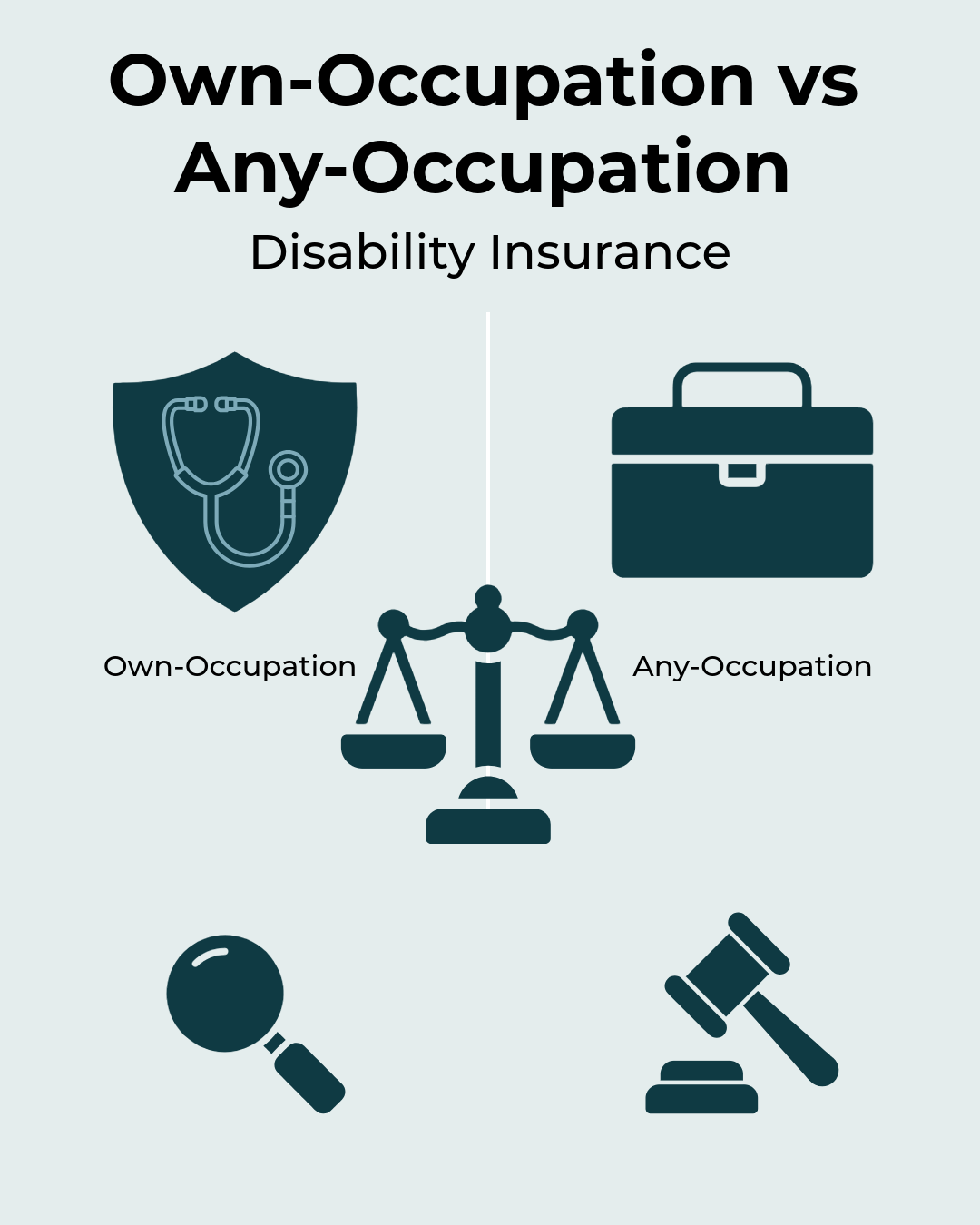
Disability insurance replaces a portion of your income if an illness or injury prevents you from working. Policies can be short-term (often three to six months) or long-term (potentially to retirement age), and the most critical clause in any policy is its definition of disability, that wording controls when benefits get paid.
Quick refresher: how disability insurance works
Long-term disability insurance is designed to replace a set percentage of your earnings, commonly in the 50–70% range, and benefits begin after a waiting (“elimination”) period. Typical features to evaluate include: the disability definition, benefit period, elimination period, residual/partial benefits, COLA riders, renewability, and potential offsets with other benefits (e.g., Social Security).
The two key definitions of disability
1) Own-Occupation
You’re considered disabled if you cannot perform the regular and customary duties of your own occupation due to a covered illness or injury. Many long-term policies start with an own-occupation definition for the first year or two of a claim (some keep it for the full benefit period). Because it’s easier to qualify under this standard, premiums are typically higher.
2) Any-Occupation
You’re considered disabled only if you cannot perform the duties of any occupation for which you’re reasonably qualified by education, training, or experience. In many long-term policies, the definition shifts to any-occupation after an initial own-occupation period, making benefits harder to qualify for thereafter.
Note: Government programs like Social Security Disability Insurance (SSDI) use their own, very strict standard, disability must prevent you from engaging in any substantial gainful activity (SGA) for at least 12 months or result in death. That’s different from private insurance but helps illustrate how demanding “any work” tests can be.
Pros and cons at a glance
Own-Occupation
Pros
Easiest path to benefits if you can’t do the core duties of your current occupation, even if you could do other work.
Often pairs with residual/partial benefits, allowing part-time work while receiving proportional payments.
Cons
Higher premiums relative to any-occupation.
Some policies limit the own-occ period (e.g., first 24 months) before switching to any-occ, verify your contract.
Best fit (commonly)
Specialists and higher-income professionals whose job-specific skills drive their earnings (e.g., surgeons, trial attorneys, executives). Rationale: protection is tied to inability to perform your specialty, not “some other job.” (General description based on regulator/industry guidance about how definitions operate; always check your policy.)
Any-Occupation
Pros
Usually lower cost than true own-occupation coverage.
Aligns with some employer group plans that integrate with public benefits (understanding offsets is important).
Cons
Harder to qualify if the insurer shows you can do work consistent with your background (even at lower pay), benefits may be denied.
When a policy converts from own-occ to any-occ after a set period, benefits can stop unless you meet the stricter standard.
Best fit (commonly)
Buyers prioritizing affordability and willing to accept a stricter definition, or those supplementing other safety nets but needing basic protection. (General description; confirm details in your certificate/policy.)
Why many policies “mix” definitions
It’s common for long-term disability contracts to start with own-occupation for a limited period (e.g., 24 months) and then transition to any-occupation for the remainder. Understanding exactly when that switch occurs (if at all) is crucial to projecting how long benefits may last.
Other levers that change real-world outcomes
Residual/Partial benefits: Let you work part-time and receive a partial benefit based on income loss—a key feature for gradual returns to work.
Benefit amount & offsets: Private benefits are usually 50–70% of pre-disability income and can be reduced by other sources if the policy includes offset provisions.
Elimination (waiting) period: Longer waits typically mean lower premiums; ensure you have cash reserves to bridge the gap.
Renewability & COLA riders: Non-cancelable/guaranteed renewable provisions and cost-of-living adjustments help preserve value over time.
Putting it together: which definition should you choose?
If maintaining your current profession (and income level tied to it) is critical, an own-occupation definition is generally considered more protective, hence why it often costs more.
If you’re cost-sensitive and can accept a higher hurdle for benefits, especially after an initial period, an any-occupation definition (or a blended own-then-any policy) may suit your risk tolerance.
Regardless of choice, buy from a licensed insurer/agent, read the exact policy language, and confirm how residual benefits, offsets, renewability, and elimination periods work in your situation. State insurance departments and national organizations provide helpful consumer checklists.
Sources (reputable, regulator/industry)
National Association of Insurance Commissioners (NAIC) - Consumer guidance on disability insurance, including how definitions vary and what to compare. NAIC
North Carolina Department of Insurance - A Consumer’s Guide to Disability Income Insurance (clear definitions of own-occupation vs any-occupation and common policy structure). NC DOI
Insurance Information Institute (Triple-I) - What to look for when buying disability insurance; explains own-occ vs any-occ and blended definitions; residual benefits. III
Social Security Administration - SSDI’s strict “any substantial gainful activity” definition (for context on “any work” standards in public programs). ssa.gov
NAIC MCAS Instructions (2025) - Regulator usage of “own occupation/job” vs “any occupation/job” terminology in disability reporting. NAIC
This article relies only on the sources cited above. If your policy language differs from these general descriptions, the policy controls.
