

Money Map Monday: The 3 Top Priorities For Your Money (Start Here)
If you want financial progress that actually sticks, stop trying to optimize everything at once. Win the big battles first. But before you begin diving into these priorities, you should first construct a budget. Creating a household budget can be a sobering exercise, but it serves two functions. The first is that it tells you exactly how much money is coming in vs how much is going out. The second is that it illustrates the cash flow needed to achieve your financial objectives. I typically recommend that my clients use RocketMoney or Simplifi when creating their household budget. You’re certainly welcome to go old school and use Excel and your bank statements, but these apps make it easier for you to track your spending as they sync up with your online bank accounts.
To construct your household budget, you’re going to want to use a minimum of 12 months of historical information. This way you can identify all recurring expenses that occur, weekly, monthly, and annually. You will also be more able to identify expenses to cut back on, and familiarize yourself with the flow of income into your household in the form of salary increases, bonuses, and investments.
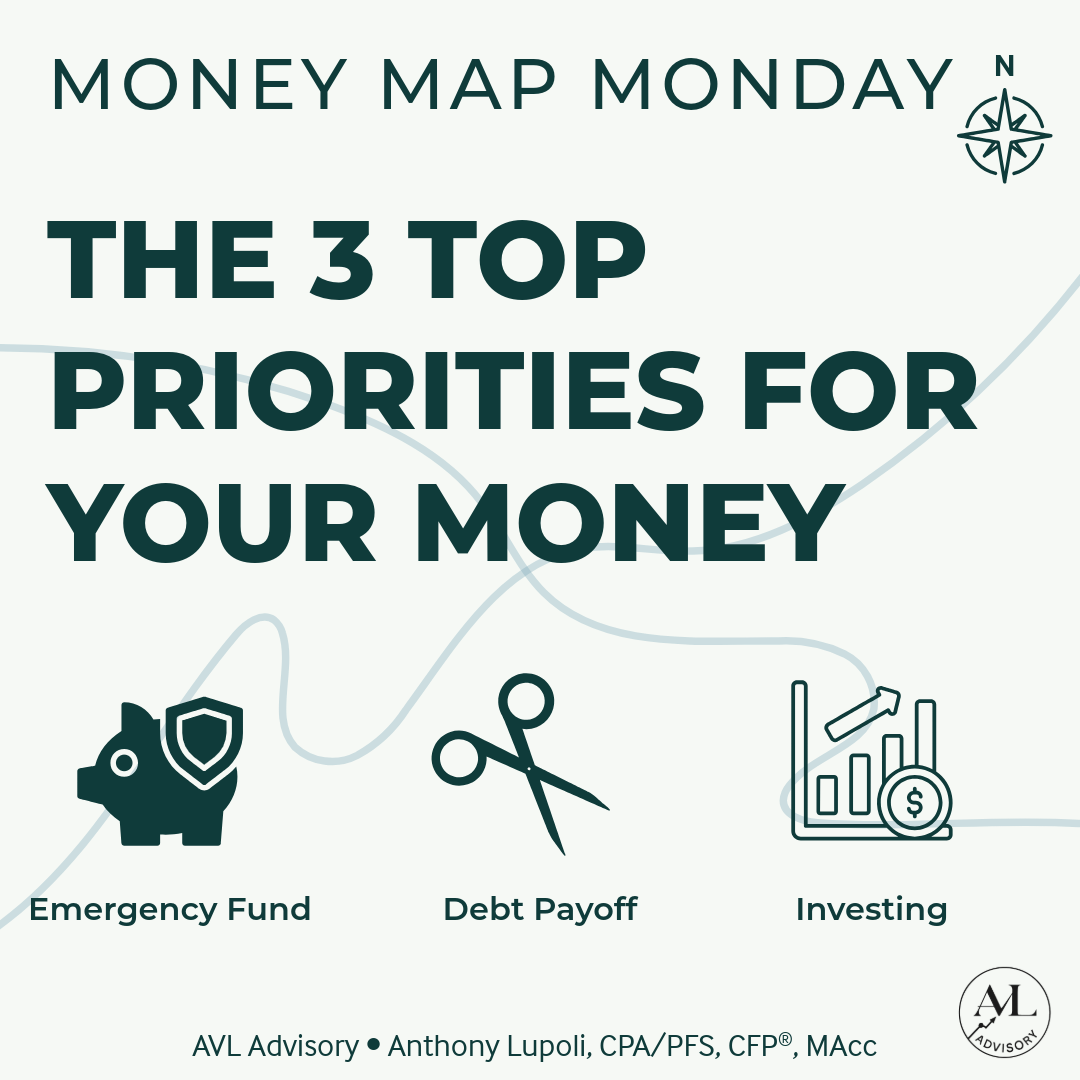
Here are the three priorities I have clients tackle, every dollar you earn should flow through this sequence before anything else.
1) Fortify Your Safety Net (Cash First, Always)
Why it matters: Cash is your shock absorber. Without it, every setback (car repair, slow month, medical bill) turns into debt and derails your plan.
Target:
Starter: $5,000+ immediately. I recommend keeping this amount in your checking account to cover immediate living expenses. Adjust this figure depending on your average months’ living expenses.
Emergency Fund: 6-12 months of living expenses (business owners: 18-24 months). This is your emergency fund to be used for…well…emergencies. This fund guards against unforeseen events such as job loss, deteriorating health, or even death. It’s required to maintain your ability to pay the bills and continue to fund your goals.
Storage: Your emergency fund should be kept in assets that are liquid. Liquidity is your ability to convert assets into cash quickly without incurring a loss to the principal amount of the asset. There is a common misconception that Certificates of Deposit (CDs) should be used for this purpose, however, they are not liquid assets since you can incur penalties upon withdrawal before their maturity date. It is recommended that households store their emergency funds in a money market or high-yield savings account (HYSA).
How to do it this week:
Open/confirm a dedicated HYSA and nickname it “Emergency Fund.”
Automate a transfer the day after each payday (e.g., $250–$1,000).
Park irregular windfalls here first (tax refunds, bonuses, side income).
Avoid: Investing your emergency fund, mixing it with checking, or chasing credit cards as “backup.”
2) Kill Expensive Debt (Guaranteed Return)
Why it matters: A 20% APR can be one the loudest expenses in your life if you let it. Paying it off is a risk-free, after-tax “return” you can’t find in the market.
Order of attack:
Toxic debt: Credit cards, buy-now-pay-later, personal loans >8–10% APR.
Gray area: Car loans and private student loans 5–8%.
Strategic: Mortgages and federal student loans ≤5% (often keep, not rush).
How to do it this week:
List balances, APRs, minimums.
Pick a method: Avalanche (highest APR first) or Snowball (smallest balance first, behavioral win which motivates you to keep going).
Automate extra payments on your target account; minimums on the rest.
Consider 0% balance transfer ONLY IF you’ll pay it off within promo period and avoid new spending.
Avoid: Paying extra on low-rate debt before you’ve erased high-rate debt or funded your emergency cash.
3) Pay Your Future Self (Automatic, Tax-Smart Investing)
Why it matters: Compounding rewards people who start early and stay consistent. Automation makes you both.
Priority order:
401(k) up to employer match (it’s free money).
HSA (if eligible): triple tax advantage; spend in retirement if not used earlier.
Roth IRA/401k (or Traditional Nondeductible IRA, depending on tax bracket & phaseouts).
Taxable brokerage for flexible goals (home, freedom fund, early retirement).
How to do it this week:
Turn on auto-contributions on payday.
Choose a simple, diversified allocation depending on your goals and risk tolerance (e.g., broad stock index + bond index) you can hold through cycles.
Increase contributions 1% each quarter or after each raise until you hit targets.
Avoid: Timing the market, owning a dozen overlapping funds, or leaving cash idle once your emergency fund is set.
Your 60-Minute Money Map (Do This Today)
10 min: Set a recurring transfer to your HYSA.
15 min: List all debts (balance/APR/min). Start avalanche or snowball.
15 min: Log into your 401(k) and raise contributions to capture the full match.
10 min: Open/verify HSA or IRA if eligible; schedule a monthly contribution.
10 min: Create a simple “payday rule”:
Dollar 1 → Emergency Fund until target met
Next dollars → High-APR debt payoff
Then → Investments (401k/HSA/IRA/brokerage)
Finally → Lifestyle upgrades
How Much Should You Invest?
As a rule of thumb:
Beginner: 10% of gross income (build the habit).
On track: 15%—20% (typical for long-term goals).
Aggressive/High earners: 25%+ (to buy flexibility and time).
If you’re a business owner, also build:
Operating cash reserve: 6-12 months of business expenses.
Quarterly tax set-aside: Separate account, funded automatically.
When To Go Beyond The Big Three
Consider layered strategies once the foundation is solid:
Tax-loss harvesting & asset location (taxable vs. tax-advantaged).
Mega backdoor Roth, cash balance plans (for higher earners/business owners).
Insurance audits (life/disability/umbrella) and estate documents.
The Bottom Line
Most people spread themselves thin and stall. The Money Map keeps you focused: Cash → Crush high-interest debt → Automate investing. Nail those, and everything else becomes optimization.
Want help customizing this to your situation? Book a 15-minute intro and I’ll map your exact numbers into this framework and show you the tax-smart order for your contributions and paydowns. Be sure to subscribe to my newsletter for more money tips.
Educational only, this is not individualized financial, tax, or legal advice. Investing involves risk, including loss of principal.
